
Category: Main Blog

Richmond Hill, Ont. to ban the number four – This is Multiculturalism

As an immigrant in the 60s, Canada is home. I lived in England, the US but chose Canada as there was comfort in how it was growing and understanding the world in which I wanted to live. Not perfect with the treatment of minority groups it was trying to change. We came from all over the world in the 60s to live together. Friends were from different cultures and ethnic groups. We were a Cosmopolitan space in the GTA and Toronto. Yes, there were groups who lived in enclaves in the city. However, their children mixed with everyone. With a high ethnic population today groups cluster together reinforcing their norms and values from their countries of origin not allowing integration into the larger Canadian society. There is a lack of inclusion, a lack of true mixing of the second generation.
What is difficult to understand is why one ethnic group with a larger population thinks it should get it way and why there is a lack of understanding that many of us left our countries to get away from that very thinking and from the divisiveness that exists in Asia, Africa and many parts of the world. Yes, Canada is Eurocentric but we knew this before we came.
One group with a larger ethnic population than another ethnic group within the same space can get what it wants despite the other group’s wishes. This is how strife is currently occurring in the Middle East between religious groups as well as different ethnic groups in that region. In Myanmar/Burma a new democracy they are trying to come together and stop fighting each other – this is a difficult process, hard to achieve. We saw the interment of our Japanese citizens in Canada during WW2. Why are we using Multiculturalism to build differences rather than coming together in diversity to celebrate what is means to be Canadian. To do this we have to leave our exclusions and bring our inclusions to Canada. When our culture teaches us that women are not equal, we leave that when we come to Canada. We do not come to Canada to change woman’s rights already achieved. The same goes for other rights.

Going down Young Street where Toronto starts, I find the signage to be confusing with scripts jumping out and making for what I call ‘Eye pollution’. Ethnic groups who want their own people to use their shops are not very neighbourly or considerate. It is only about their group with no consideration for those of us who need to find a place while driving, or an elderly person living in the area of a different background finding it difficult to read the signs. This is about civility – we are living in Canada and not in that country. Why are those of us who are not from that ethnic group subjective on a main street to this signage?
Now I hear that the Number 4 is not to be used in housing in Richmond Hill. This is wrong. The Chines do not have to buy #4 homes. This would be good for the city as it would then allow those who do not have the Si – 4 meaning death to buy those homes and make the city more cosmopolitan. Why is this issue important? There are numbers in every culture with meanings and their our words that are not politically correct. We need to be free to choose and speak.
I speak about The Cappuccino Principle and how the cream on the top needs mixing. We are very sure about racism and how we need more equity – we write about this openly. Yet the same scholars who speak to this are silent when ethnic groups push for their views over the views of other ethnic groups or the dominant group. What gives Diaspora groups more rights than the white population?  My answer:  we are afraid of being called intolerant. Politicians and city officials are scared of the loss of votes in the next election.
Feeling of hate around the world – hate speech

This week has not been a good week globally. The killings in Syria, in North Lebanon, Iraq, then in Britain and France – all due to religion. In Myanmar, there was a law passed regarding Muslim Rohingyas and a 2 child policy. The use of social media, the pulpit and other sources of power are being used to make hate statements. Taken separately, it may not be enough to to use the word hate and then related to it to hate speech.
This issue is important when we add gender and sexual orientation.
In Canada, born-again Christian William Whatcott was guilty of hate speech  against homosexuals.  Global leaders denounced what they called a spike in anti-Islamic sentiment in Europe and Asia. Countries such as India have used laws to prevent hate speech – an example – Swami Kamalanand Bharathi, Tanzania has banned religious hate speech in all its manifestations and in Myanmar while Buddhist monk Wirathu speaks out against Muslims; multifaith activists there taking to the streets to counter the violence.  US citizens have free speech and therefore cannot do much against those who spew hate. Hate speech is not free speech.
There must be accountability and action.

When we hear religious leaders denouncing Western values in Western countries and then the analysis regarding this speech as a “Clash of Civilizations” we need to question what this means. I consider some points in this analysis as false discourse. We do not have universal aspirations for dignity and we see actions that kill women and children without thought.
The 38 + countries that have a human rights and social justice agenda have struggled with minority rights and have progressed to a point where women, LGBT groups, people with disabilities, and racialized groups have obtained in policies their rights.  Those who wish to live in these countries must know they are in countries that allow women to make their own decisions, have equal rights and status. I am told that many come to Canada and like countries for economic reasons and not for our values that allow women to be who they wish to be, keeping their daughters and wives as “in the old country.” We saw in London this week two British born men using violence to make a point. It is therefore not a Clash of Civilizations but rather a disrespecting of other peoples norms and values to the point of taking lives. Where did they learn to hate so deeply and disrespect a life?
Hate speech must be stopped, and it our political systems around the world that must take the lead. When they do not use their laws against those who encourage hate, that country will only encourage more hate.
In the name of religion, appointed leaders and some of their followers think they have the freedom to speak hate towards the other.  They incite youth and those who are socially dislocated to be filled with hate. For some this hate becomes action.

Can we stop the violence in Myanmar/Burma

News from Myanmar/Burma is either mostly about economics or how some violence has occurred. We hear of conflicts based on perceptions, history, and wars. Trust and respect is difficult to grow and thrive in this environment

Fear and distrust causes violence in many different forms. There cannot be an acceptance of behaviours that result in trauma or learned helplessness. Perhaps the individual threshold towards abuse is higher as it has become more the norm than the exception after years of oppression. This is not a new idea as history shows how oppression can manifest oppressive group behaviours. We need to understand the relationships of economic power, and social power between people within a social group and between groups. Perhaps those who speak for ‘the group’ is not really speaking for ‘the many’ but for ‘the few’ who wish to control the voices of their communities. The silent majority in Myanmar is alive and well, just like us in Canada.

Social justice with its history in religion and philosophy is difficult to define but is viewed as part of our social fabric. The area of social and economic justice has many dimensions and provides a springboard to pursue non-supportive behaviours and injustices within societies, as well as provides a path to help heal both economic and social woes. When authority is diversified then no one becomes accountable for oppressive behaviours that occur in all societies.

Social exclusion will occur when structural process allow for inequalities that arise out of oppression related to race, class, gender, disability, sexual orientation, immigrant status and religion to exist within the social and professional environments; and when the government abdicates its responsibility. Societies must grant women equal rights not only in public spaces but also within the family, and community. Economics and religion cannot be used as an excuse for any denial for equal rights. Civil society is needed to ensure that is not just race/racism  is viewed as important but that gender, sexual orientation, as well as class is viewed as part of the complex nature of rights.
Central to the idea of breaking down barriers is creating partnerships with progressive leaders in order for subordinated groups to work with them on problems of exclusion. Pointing fingers has not helped race relations in Canada, and it will not work in Advocacy. Building coalitions and framing the discussion takes energy. Energy comes when we support each other and enlist progressive leaders to the cause.

It is my desire for us in Canada to work together to help bring unity and peace not only in Myanmar/Burma but also in Canada. Advocacy is a big part of this. How can we together  help change the dynamics of violence?
Merle A. Jacobs

Speaking, Hearing and Understanding the Stories We Hold as Health Care Providers

Research colleagues that I enjoyed working with on this project.

Speaking, Hearing and Understanding the Stories We Hold as Health Care Providers
Patricia McGillicuddy, Tracy Johnson, Phyllis Marie Jensen, Margaret I. Fitch, Merle Audrey Jacobs

The authors focus on the results of a qualitative study by a team of social work and nursing researchers investigating the nature and extent of vicarious traumatization in the work experience of 20 physicians, nurses, and social workers during professional training and in clinical practice.  The authors take a qualitative, narrative approach to understanding the professional care experiences and workplace context reflected in stories that are remembered as difficult, unresolved, or worrisome. A number of recurring themes emerged from the research as contributing to the development of vicarious traumatization and aiding or hindering its resolution.
There was significant overlap among both the themes and the nature of the stories told among the professions interviewed. The deliberative delineation of these themes in education, mentorship and practice may assist in recognizing and ameliorating traumatic effect and enhancing hope and pride. This points to the need for heightened awareness and interdisciplinary education focused on the emotional impacts of working with patients/clients in health care team settings and the powerful potential of storytelling.

http://www.casw-acts.ca/en/csw-abstracts

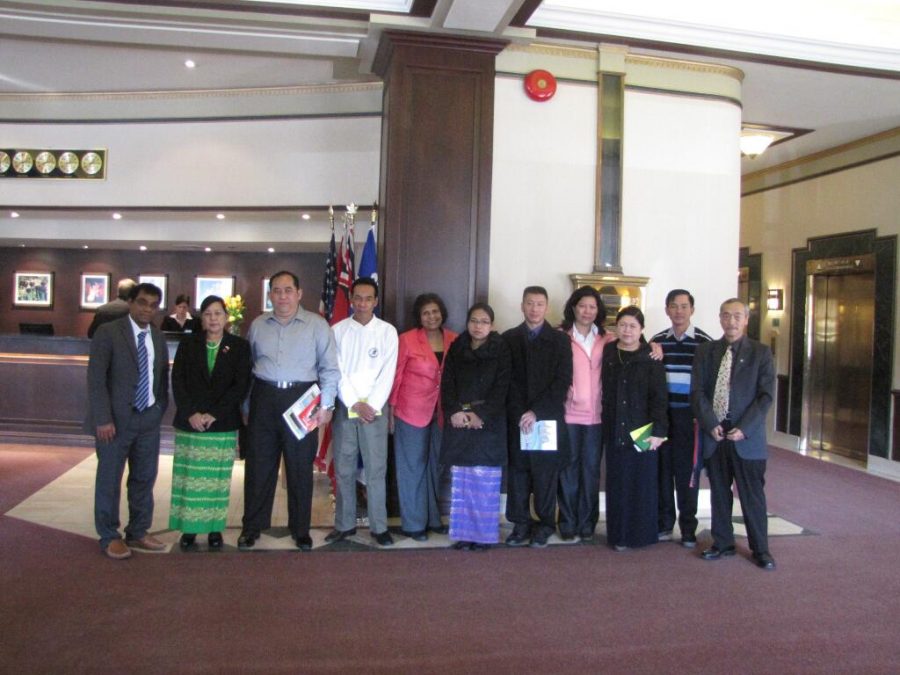
11-member Burma parliamentary delegation meets with CFOB which I Chair

Information Release by Canadian Friends of Burma – April 26, 2013 (for the full release please view guest blog on this site)

Ottawa – An 11-member Burma parliamentary delegation visited Ottawa this week in exchange of the Canadian parliamentary delegation sent off to Burma earlier this year.

A day before their departure, the delegation met the executive members of CFOB Board of Directors at the Lord Elgin Hotel in Ottawa on April 26, 2013,

Executive board members of CFOB who met the delegation are as follows:

1.     Dr. Merle Jacobs (Chairperson)
2.    Mr. Timothy Zaw Zaw  (Vice-Chairperson)
3.    Ms. Thet Thet  Htun (Secretary)
4.    Mr. Tin Maung Htoo

In terms of my visit, I found all members to be interested in education for the peoples of Burma. The females MPs and I had a chance of speaking 1:1. Their concerns included economic development which would help the population. Having not spoken Burmese for decades, I was able to understand most of the discussion but could only speak a few sentences. This meeting was productive and informative. I provided a copy of my book Women’s Work to each member; sending one to Daw Aung  Suu Kyi.

Collegiality

Collegiality is a research area of interest. I have looked at this issue as it related to professionalism within nursing, a female dominated profession.

My first survey in 1994, some 19 years ago, provided data that started the process in the area of collegial .

The analysis from my data provided original and multiple insights about contemporary female occupational cultures. It is disheartening to find out from colleagues (Lister, 2013; Brinkert, 2010) how women’s work environments are at a decline in many ways. The implication of work milieu in current research associates this environment with negative professional behaviours and quality of patient care.

Most mainstream studies on the nursing profession – usually the only available texts – tend to adopt a simplistic framework of “problems and prospects”, whereas my research has assembled data regarding the unhealthy contradictions perpetrated by the professional/ collegial values and routine practices. Here, however, we see the social reproductions of institutionalized injustice, notably the ethos of white superiority. The silent voices of the “racialized” others speak loudly to the dominant culture of compliance that is protected in self-serving professions. Rather than debunk mythologies, I consider those themes that have been woefully overlooked in studies of professions—social justice. Justice, an increasingly significant theme in public policy and multicultural programs, provides a direction that is long overdue in addressing micro conflicts within macro contexts.

Canadians! wake up; Where are your jobs going?

  1. RBC article Kathy Tomlinson                                    
  2. Advocate! Click on  MP  – as you owe this to yourself.  This is not fair.   
  3. Our students pay at least $1000.00 a course, take 20 courses and then cannot find work in Canada.

Awakening to the news today, and after speaking to a graduate student, I found myself not only upset but angry.
The IT  professor on CBC’s The Current was not in the least upset that his students would have to upskill   – as he said, because their jobs could go to less expensive labour markets somewhere out there in our global world. My first question out loud – then why are you teaching them YOUR course which pays you and will cost them?

The RBC ‘s action to use a third party is not about pitting worker against worker but points to a larger problem.  Canadian companies in Canada are taking jobs from Canadians and are providing jobs in foreign countries while selling their products to Canadians. Help me understand. Some on the left do not wish to talk about ‘foreign workers’ as it involves issues of social justice, but please look at our population in Toronto. These are the children of ‘foreign immigrants’ who need to work in Toronto. This is not about migrant workers, this is about profit at all cost. On the right, they just don’t talk about bad social policies.

The bottom line, we need work for our graduates. Thay cannot find work even at Tim Horton’s  (where you find them studying) who received premission to bring in temporary workers – 15,000 of them in 2012.
When I came to Canada, a racialized woman it was about a country where one came to develop and contribute. Today, we ask new Canadians to come, and to work, yet the very talent that brought them to Canada is out sourced to countries like India.

As well, our graduates should not have to go to China or India to find work while their jobs are  taken to these countries by third parties who are also registered with our government to insource 15% cheaper labour.

The  Harper Government is responsible for this deplorable sitution, and while MPs discuss this issue -Canadians are displaced from their jobs. This vision of cheap labour is outdated and careless.
54,500 jobs lost in March. Canadians have been careless as well. We need to write our MPs and hold them responisble for this and other actions. After all we pay them and they need to be held accountable.

Welcome!

This is a platform for my thoughts, analysis and understandings of the world in which we live. My views are based on the reading I have done over the years.
Of course I know there are many roads to Rome. However, I have lived most of my life in Canada and do not know much about roads to Rome. 🙂
Great meeting me on this blog. Have a great day and welcome.

Social justice + equity = a better life together .


Page 6 of 6

Powered by WordPress & Theme by Anders Norén